
Commercial Tile Installation
High-traffic spaces in South LA — installed with the prep and tolerances the job demands.
Commercial Work Is a Different Set of Requirements
Commercial tile installation carries demands that residential work does not. The tile itself needs a higher PEI (Porcelain Enamel Institute) hardness rating — residential tile is typically rated PEI 3 or 4, while a retail floor or commercial corridor needs PEI 4 or 5 to withstand constant foot traffic, wheeled carts, and cleaning equipment. We specify materials appropriate for the use case, not just for the look.
Scheduling matters differently on a commercial job. A retail space has operating hours; a restaurant cannot close its kitchen for three days; an office building has tenant expectations. We work with your schedule — early mornings, weekends, phased sections — to minimize business disruption. We also work with modified thin-set formulations that achieve higher early bond strength, which shortens the time before a surface can be walked on and reduces your downtime.
The substrate on a commercial slab is often in better condition than residential wood-frame construction, but it brings its own challenges: control joints that need to carry through to the tile surface as expansion joints (skipping this step causes tile to crack along the joint line), larger square footage requiring precise layout to avoid slivers at walls, and sometimes the need to coordinate with other trades on a renovation timeline.
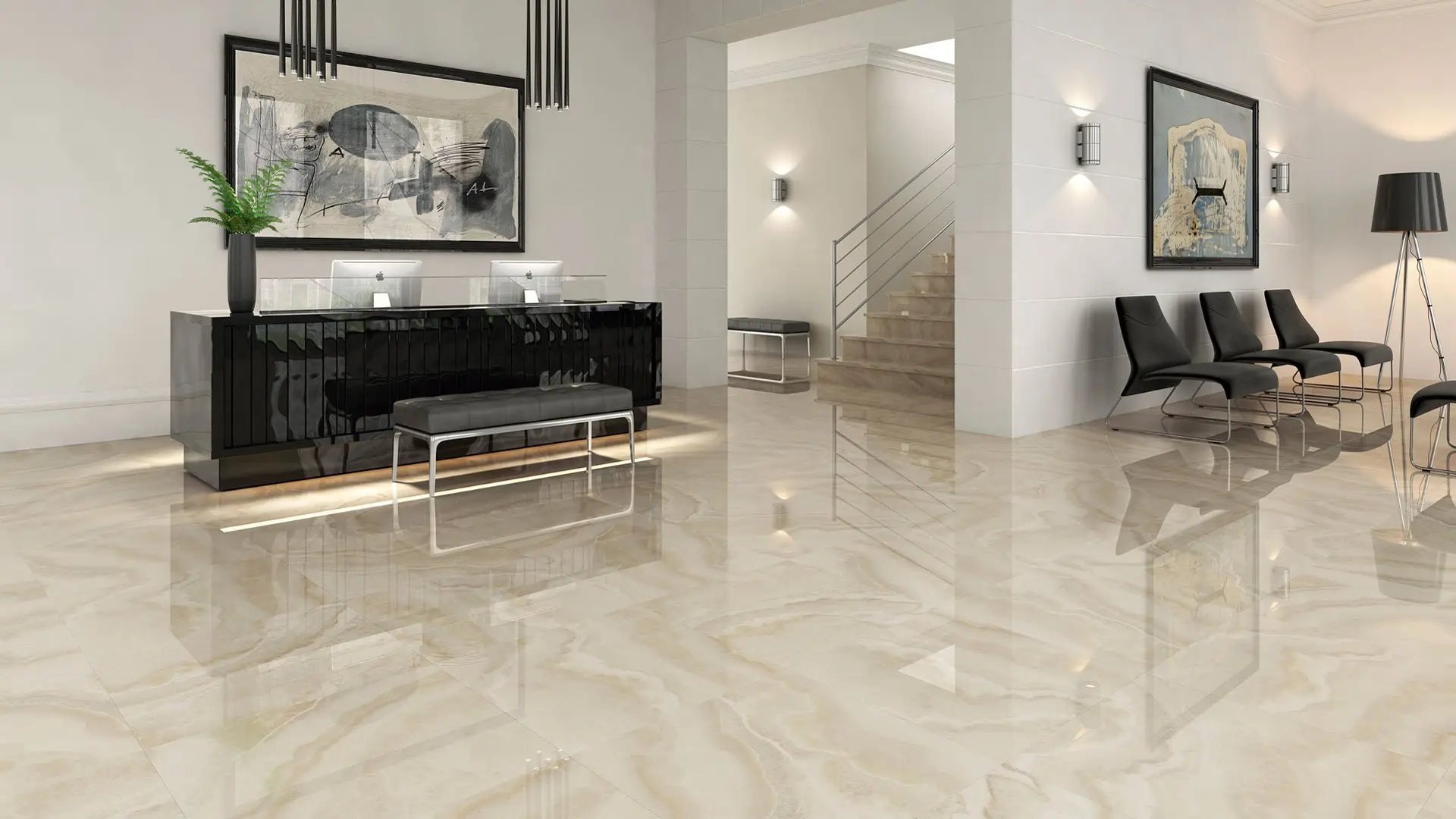
Commercial Process Overview
Site Assessment
We visit the space, evaluate the concrete substrate for flatness and moisture vapor emission, identify existing control joints, and measure the layout. Commercial slabs often have moisture vapor emission rates that require a vapor-suppression primer before thin-set — we check this before quoting.
Material Selection
We advise on tile hardness rating, slip resistance coefficient (commercial floors in wet areas need a DCOF of 0.42 or higher per ANSI standards), and format relative to the space proportions. We do not specify materials we cannot source reliably.
Substrate Preparation
Grinding, leveling, priming, and control joint mapping. For large commercial floors, we use a power screed to apply floor leveler efficiently. Control joints in the slab are mapped and carried through the tile installation as expansion joints filled with flexible sealant, not grout.
Installation and Grouting
Large-format tile on a commercial floor requires a large-notch trowel (typically 1/2" x 1/2" or larger), back-buttering, and a leveling system. Grout joints are kept consistent throughout. Epoxy grout is standard for commercial kitchen and food service areas.
Protection and Handoff
Finished tile gets covered with ram board or kraft paper during remaining construction activity. We do a final walkthrough with you before handoff to verify flatness, grout consistency, and expansion joint placement.
Where We Work
Commercial tile installation is available in Vermont Knolls, Manchester Square, Westmont, and surrounding South LA commercial corridors. Call us to discuss your project timeline and space requirements: (626) 642-5980.